
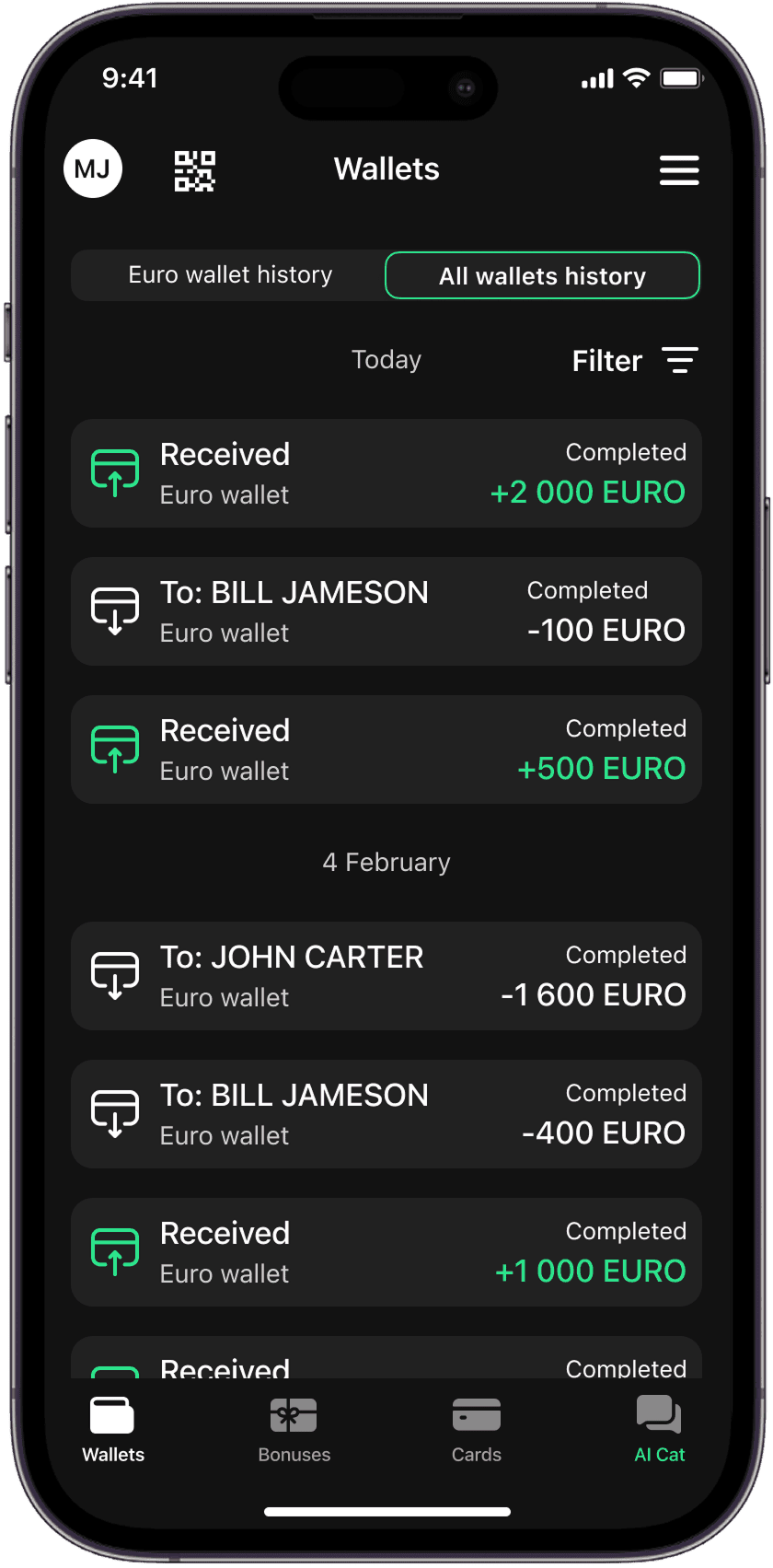
Since October 2025, a euro transfer that would once have gone through on the IBAN alone can now be stopped and ask you for the recipient’s name.
This is the most visible change to European payments in years, and it is the reason that a large share of transfers that fail today fail due to recipient data rather than anything to do with the sender’s account.
A Blackcat transfer blocked at the point of confirmation, or the equivalent at any euro-area provider, is often this check firing rather than a compliance hold. The two look similar on screen and have entirely different resolutions.
The rule and the date
The Instant Payments Regulation, Regulation (EU) 2024/886, requires payment service providers in the euro area to offer a Verification of Payee service from 9 October 2025. The European Commission described the change plainly when the obligations took effect: providers must offer clients the ability to send instant euro payments. They must offer payee verification so that the payee’s name is checked against the IBAN before processing a payment.
Three details matter for anyone using a euro account. The obligation covers all SEPA euro credit transfers, both standard and instant, not only the ten-second ones. The same name-and-IBAN check applies when sending from a euro iban account.
For businesses and individuals making euro payments, having a reliable euro iban account can make the payment process smoother and more transparent. With payee verification checking the recipient’s name against the IBAN, users can review the details before completing a transfer and reduce the risk of sending funds to an incorrect account.
It applies to every provider in the euro area, including electronic money institutions such as Blackcat’s issuer Papaya Ltd. (licensed by the MFSA, licence number: C55146). And providers outside the euro area have until 9 July 2027, which is why a transfer to a non-euro Member State may behave differently.
The four possible answers
The check compares the payee name you typed against the name the receiving institution holds for that IBAN, and returns one of four results. The important thing is that none of them automatically stops your payment.
| Result | Meaning | What to do |
|---|---|---|
| Match | The name and IBAN correspond | Proceed normally |
| Close match | Similar but not identical — often a legal name against a trading name, or a missing middle name | Check against the invoice or the recipient’s own written details before proceeding |
| No match | The name does not correspond to the IBAN holder | Stop. Confirm the details with the recipient through a channel you initiated |
| Not possible | The receiving institution could not answer, for example, outside the euro area | The check gives no assurance either way; verify the details independently |
Verification of Payee outcomes and what each means for the payer.
Source: Regulation (EU) 2024/886; European Central Bank, Instant Payments Regulation.
The liability point is the one to internalise. Where you are warned of a discrepancy and authorise the payment anyway, you carry the loss if the money reaches an unintended recipient. That is a change in position for consumers, converting the warning screen from an informational notice into a decision point with consequences.
Why a close match is common and usually harmless
Close-match results are frequent and mostly benign, which creates a habituation risk. A business trading as “Rossi Design” may hold its account as “Rossi Comunicazione S.r.l.”. A person registered as “Maria Elena Costa” may have given you “Maria Costa”. A transliterated name may differ by one letter.
The distinction to hold on to is between a name that is a variant of the same entity and one that belongs to someone else. “Rossi Comunicazione S.r.l.” against “Rossi Design” is plausibly the same business.
A wholly different personal name on an invoice from a company is not a variant; it is the classic signature of an invoice interception scam.
A worked case of the scam the check targets. A construction firm in Dublin receives what appears to be a follow-up email from a supplier it has paid monthly for two years, notifying it of a change in bank details.
The name on the invoice is unchanged. Before October 2025, the payment would have gone through on the new IBAN without comment. Now the payee check returns no match because the account associated with that IBAN belongs to someone else entirely, and the discrepancy appears on screen before the payment is confirmed.
Verifying against the invoice is not sufficient on its own because the invoice may be the thing that was altered. Where the amount is consequential, confirm the account details by contacting the recipient at a number or address you already have, not one supplied in the message that carried the payment request.
How does this fit the fraud picture?
The rule exists because of the concentration of European fraud losses. The European Banking Authority and the European Central Bank reported that the total value of fraudulent payment transactions across the EEA reached EUR 4.2 billion in 2024, with fraudulent credit transfers accounting for EUR 2.5 billion, the largest share by value.
Their data also showed that payment service users bore around 85% of credit transfer fraud losses in 2024, mainly through scams in which users were deceived into initiating payments.
A name check does not address every one of those cases. Someone deceived into paying a genuine account held in the fraudster’s own name will get a clean match. What it does address is the family of scams that rely on substituting account details behind a name the payer trusts.
Other reasons the recipient data stops a transfer
● An IBAN that fails its check digit, usually a transposition when typing.
● A closed or dormant account at the receiving institution, which produces a return rather than a warning.
● A reference field containing characters that the scheme does not accept.
● A payment to a country or currency outside the account’s permitted scope under the provider’s terms.
● An account at the receiving institution that cannot accept the transfer type, for example, a savings product not enabled for incoming SEPA credits.
These fail at different points in the chain, which is why the wording differs. A check-digit failure stops before submission. A closed account produces a reversal days later. Where a transfer has been returned rather than blocked, ask the recipient what their institution recorded as the return reason.
Frequently asked questions
Can I still send a transfer after a no-match warning?
Yes. The check informs you rather than blocking the payment. But where you authorise a transfer after being warned of a discrepancy, you are liable for the transfer if it reaches an unintended recipient.
Why did my transfer to a non-EU Eurozone country not show a name check?
Providers in Member States outside the euro area have until 9 July 2027 to offer Verification of Payee. Until then, the check may return a “not possible” result for those destinations.
Does the payee name check cost anything?
No. The Instant Payments Regulation requires that the service be provided to the payer without an additional charge for euro credit transfers.
This article explains the Verification of Payee requirements introduced by Regulation (EU) 2024/886 and other common reasons a euro transfer fails on recipient data. It is general information rather than legal or financial advice. Implementation details, screen wording and the handling of individual results vary between providers, and the liability position in any particular case depends on the facts and on the applicable national law. For a specific failed transfer, contact the provider that holds the account.
